October fuel observations: what does a litre mean for your trip budget?
An original analysis of Casablanca observations dated 1 October 2026, with fill-up calculations and the limits of comparing cities.
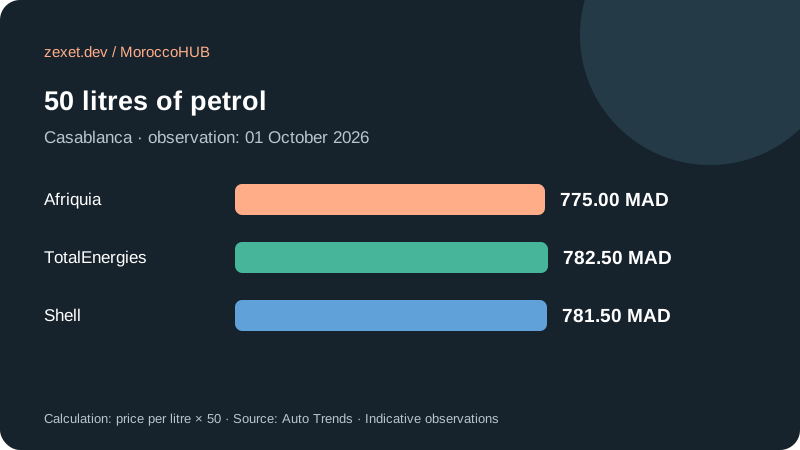
An original analysis of Casablanca observations dated 1 October 2026, with fill-up calculations and the limits of comparing cities.
What we verified
We checked the Auto Trends barometer on 4 October. Its latest displayed observation was dated 1 October 2026. Petrol was MAD 15.50 per litre at Afriquia, 15.65 at TotalEnergies and 15.63 at Shell. Diesel was 16.10 at Afriquia and TotalEnergies and 16.18 at Shell. These are indicative Casablanca observations, not a nationwide tariff.
From a litre to a fill-up
Multiply the price by the number of litres to see a comparable total. For a hypothetical 50-litre petrol fill-up, the three observed prices produce MAD 775, 782.50 and 781.50. The difference between the lowest and highest examples is MAD 7.50. This is arithmetic based on the stated observations, not a commercial offer or a promise about any particular station.
For diesel, 50 litres cost MAD 805 at a price of 16.10 and MAD 809 at 16.18. That MAD 4 difference applies to the assumed quantity. Comparing the final amount can be more useful than looking only at a small difference in the price per litre.
Estimate a journey
Assume a vehicle uses 7 litres per 100 kilometres. A 250-kilometre journey then requires 17.5 litres in the calculation. At a petrol price of 15.50, the fuel estimate is MAD 271.25. It excludes tolls and parking, and does not predict identical consumption in traffic or on a mountain road.
Use the platform calculator with your journey distance and your vehicle's own consumption. If your city has no published observation, enter the price you saw at the station. This remains a personal estimate; it does not become a public observation for that city.
Why the city matters
A city appearing in a selector does not establish a price there. A useful observation needs a location, a date and an identifiable source. The platform therefore shows an explicit missing-data state rather than presenting a Casablanca price under another city's name.
Official living-cost indices can help explain trends in other cities, but they do not give the retail price of a litre. Percentage indices and prices in dirhams answer different questions.
Following changes
The platform checks the source hourly and retains the publisher's observation date. If the table stays unchanged, the price remains dated 1 October; a successful connection does not turn it into today's observation. Failed checks keep the last successfully verified data and display the check status. This separates new evidence from a new check of existing evidence.
Sources
Sources
- Baromètre du carburant — relevé du 1 octobre 2026 · Auto Trends