El Mansouri presents her programme: 5% growth, 1,000-dirham social aid and a 3,000-dirham minimum pension
On 19 October 2026 Head of Government Fatima Ezzahra El Mansouri presented the 2026–2031 government programme to both houses of Parliament. Key figures: 5% annual growth, direct social aid raised to 1,000 dirhams and a 3,000-dirham minimum pension. We are tracking 17 of its commitments.
What happened?
On Monday 19 October 2026 Head of Government Fatima Ezzahra El Mansouri presented the 2026–2031 government programme to a joint sitting of both houses of Parliament, under Article 88 of the Constitution . Each house then debates it, and the House of Representatives votes on it: the government takes office if it wins the confidence of an absolute majority of members (198 of 395); the announced majority holds 207 seats.
The headline figures
Economy and public finances
- 5% average annual growth over 2027–2031, with inflation around 2%.
- A budget deficit around 3% of GDP and public debt around 62% of GDP in 2031.
- The private sector's share raised to two-thirds of national investment.
Purchasing power and social protection
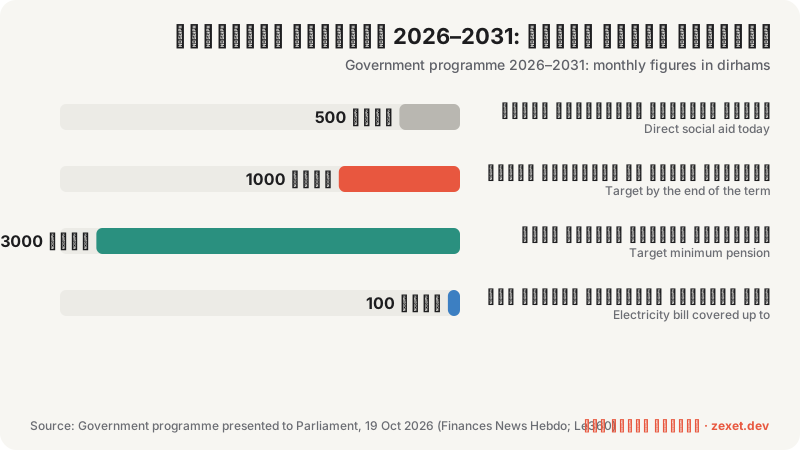
- Direct social aid raised from 500 to 1,000 dirhams a month by the end of the term.
- A 3,000-dirham minimum monthly pension, and widows' pensions at 100% of the deceased spouse's pension.
- Electricity bills covered automatically for eligible households when they do not exceed 100 dirhams a month.
Youth and jobs
- 100,000 young people trained each year from 2027 to match business needs, plus 100,000 first work experiences.
- Apprenticeship capacity raised to 150,000 to 200,000 a year.
- At least 30% of the value of large public contracts reserved for Moroccan SMEs.
Territory, housing and sovereignty
- 100,000 rural homes with 40,000 dirhams of direct aid per family.
- At least 12 billion dirhams a year transferred to the regions from 2027.
- More than 52% renewables in the electricity mix by 2030, and 1.8 billion cubic metres of desalinated water by 2031.
- 80% of pupils mastering basic skills by 2031, and zero school dropout by 2030.
- 26 million visitors by 2030.
What does it mean for you?
If these commitments are met, a household receiving 500 dirhams of direct aid today would receive twice that by the end of the term, and a retiree with a pension below 3,000 dirhams would be lifted to that floor. But the programme has not yet set a detailed timetable, eligibility rules or funding; those will appear in the annual finance laws, starting with the 2027 bill.
How we track these promises
We have added 17 commitments to the "Government promises" page in the Politics section. Commitments tied to an official indicator (growth, debt, deficit) are checked automatically against official figures as they are released; the rest stay "unverified" until an official source measures them. We do not grade the government at the start of its term.
What we do not know yet
- The full official text of the programme: we have not found it published yet, and the figures above come from two matching press accounts.
- Numeric targets for net job creation and women's activity rate: not given in the presentation according to the coverage.
- When the investiture vote will be held, and its result.
Sources
- Programme gouvernemental : El Mansouri dévoile ses sept priorités pour 2026-2031 · Finances News Hebdo
- El Mansouri dévoile sa feuille de route: un programme axé sur l’État social, la discipline et la souveraineté · Le360
Institutions involved
More news
- Two days after her appointment, the King ends Minister Delegate Madiha Khayr's duties at the Head of Government's request
- Finance 2027: a Council of Ministers approves the broad lines and five priorities, purchasing power first
- The King appoints the El Mansouri government: 32 members and a new ministry for artificial intelligence
- A four-party majority with 207 seats: who governs and who opposes in the new parliament?
- The new parliament gets to work: a royal speech sets priorities, and Touizi is elected Speaker with 220 votes