Finance 2027: a Council of Ministers approves the broad lines and five priorities, purchasing power first
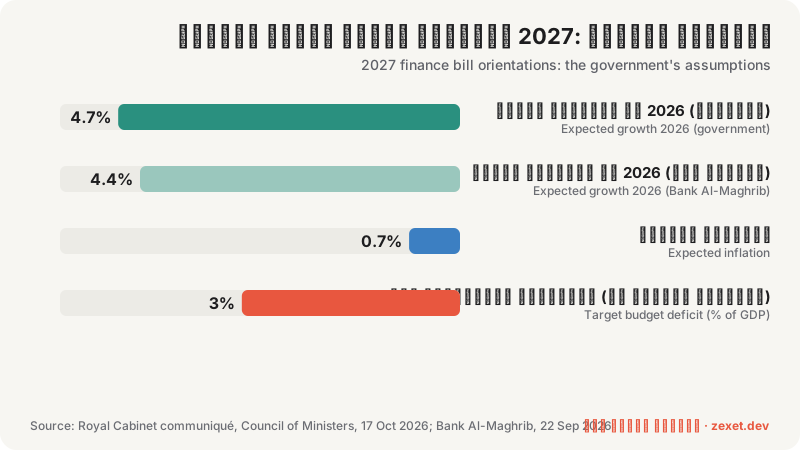
On 17 October 2026 King Mohammed VI chaired a Council of Ministers that approved the broad lines of the 2027 finance bill: expected growth of 4.7% in 2026, inflation around 0.7%, a target deficit of 3% of GDP, and 25 billion dirhams for territorial development.
What happened?
On Saturday 17 October 2026, at the Royal Palace in Rabat, King Mohammed VI chaired a Council of Ministers to deliberate on and approve the broad lines of the 2027 finance bill, according to a Royal Cabinet communiqué . The Minister of Economy, Finance and Public Performance presented the bill's main lines under Article 49 of the Constitution .
The council met the day after the government was appointed, two days before the legal deadline for tabling the bill in Parliament (20 October).
The government's figures
- Growth: about 4.7% by the end of 2026 .
- Inflation: around 0.7%.
- Budget deficit: reduced to 3% of GDP.
- Territorial development: 25 billion dirhams to speed up the new generation of integrated territorial development programmes .
For comparison, Bank Al-Maghrib forecast 4.4% growth for 2026 on 22 September . The government's assumption is therefore slightly more optimistic; the communiqué does not explain the gap.
The five priorities
1. Restoring purchasing power and strengthening the social state: a structural reform of markets and prices from next year, higher direct social support, wider health coverage, upgraded health and education, and a direct housing-support programme.
2. Youth integration: a national integrated programme for 2027–2031 covering training, career support and access to finance, guarantees and public contracts.
3. Advanced regionalisation: redefining regional powers, State–region contracts, and full implementation of the administrative de-concentration charter.
4. Strategic sovereignty: in water, energy, food and digital, from water security to renewables and green hydrogen.
5. A strong economy: financing social and sovereign ambitions while keeping macroeconomic and financial balances.
What does it mean for you?
These are broad lines, not yet measures with figures for each household. How much direct social support will rise, how the price reform will work and who qualifies for housing support will appear in the bill tabled in the House of Representatives, then in its debate and amendments.
What we do not know yet
- The full text and tables of the finance bill.
- The size of the direct social-support increase and what the "structural reform of markets and prices" involves.
- The growth assumption for 2027 itself; the communiqué only gave the end-2026 expectation.
Sources
- مجلس وزاري برئاسة الملك يضع دعم القدرة الشرائية في صدارة أولويات 2027 · هسبريس
- مجلس وزاري برئاسة الملك يصادق على التوجهات العامة لمشروع قانون مالية 2027 · المساء 24
- Bank Al-Maghrib keeps key interest rate unchanged at 2.25% · Yabiladi
Institutions involved
More news
- El Mansouri presents her programme: 5% growth, 1,000-dirham social aid and a 3,000-dirham minimum pension
- Two days after her appointment, the King ends Minister Delegate Madiha Khayr's duties at the Head of Government's request
- The King appoints the El Mansouri government: 32 members and a new ministry for artificial intelligence
- A four-party majority with 207 seats: who governs and who opposes in the new parliament?
- The new parliament gets to work: a royal speech sets priorities, and Touizi is elected Speaker with 220 votes